

Start your day by whizzing a decadent Chunky Chocolate shake in the blender at only 230 calories, and why not try throwing in some ice for a thicker and frothier shake?
Feeling peckish mid-morning? A bowl of raspberries provides a quick low-calorie burst of vitamins, antioxidants and fibre. With 30 raspberries for 30 calories, it would be rude not to!
We’ve got lunch sorted for you with our Café Latte ready-to-drink shake at 204 calories, perfect on-the-go or at your desk during a busy work day.
We know that 3pm brings afternoon munchies, so crack open a packet of our Cheddar Flavour Bites – only 92 calories with a delicious crunch.
For dinner, tuck into a delicious and satisfying pick-me-up seafood paella at only 593 calories per serving, and 42g of protein! A tasty dish, sure to make the whole family happy.
Dessert has got to be a sliced banana on a sticky bed of peanut butter - a tablespoon of delicious reduced fat peanut butter comes in at 83 calories, with 80 calories for 90g of banana.
That’s a day in the life of SlimFast sorted, and it comes in at just over 1,300 calories!
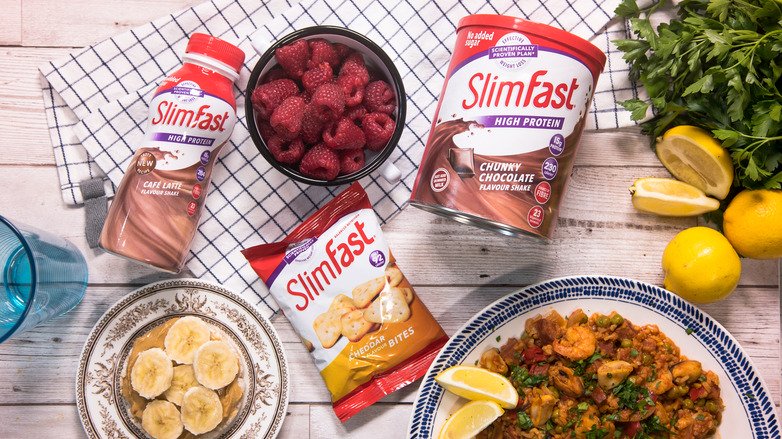
A Day In The Life of SlimFast
Related Posts
What is GLP-1?
GLP-1 is short for glucagon-like peptide-1. It’s a hormone, one of the chemical messengers your body uses to send signals from one place to another. You make it yourself, every day, in your gut. It’s a completely natural part of how your digestive system talks to the rest of your body. Think of GLP-1 as one of the messengers your gut sends out after you eat. When food arrives, specialised cells lining your intestine release it into the bloodstream, where it helps coordinate what happens next: how your body handles the energy from your meal, and how full you feel.Where does it come from? GLP-1 is made by special cells in the lining of your small intestine and colon, known as L-cells. These are part of a much bigger system: the gut is the largest hormone-producing organ in the body, quietly releasing dozens of signals as food passes through, controlling food signals, hunger and appetite and energy levels. These L-cells sit there waiting, and when the food you’ve eaten reaches them, they respond by releasing GLP-1. At rest, levels are low; after a meal, they rise, then settle again. It’s a normal daily rhythm that’s been going on inside you your whole life, long before anyone gave the hormone a name. (Scientists first identified GLP-1 in the 1980s, after mapping the gene it comes from.)A quick sense of scale When you haven’t eaten for a while, the active form of GLP-1 in your blood sits at a low baseline. After a meal, it can rise to roughly two to three times that level, with the exact amount depending on how big the meal is and what it contained. In other words, eating is the natural trigger, and your body is designed to respond.What does GLP-1 actually do? GLP-1 is a natural hormone your gut makes after you eat, and it helps with feeling full, the pace of digestion, and steady blood sugar. Researchers describe it as a “gut-brain” hormone because it helps your digestive system and your brain stay in conversation about food and energy. Its best-understood natural roles include: Helping you feel full. GLP-1 is one of the signals involved in satiety, the comfortable feeling of having had enough to eat. It’s part of how your body knows a meal has landed. Slowing the pace of digestion. It helps regulate how quickly your stomach empties, so the contents of a meal move through at a steady rate rather than all at once. Helping manage blood sugar. GLP-1 is what scientists call an “incretin” hormone. After you eat, it helps your body release insulin in response to rising blood sugar, part of keeping your energy on an even keel between meals. All of this happens automatically. You don’t feel GLP-1 being released any more than you feel any other hormone; it works in the background as part of normal digestion.GLP-1 and the science of feeling full Hunger and fullness aren’t just about willpower, they’re managed by a web of hormones, of which GLP-1 is one. After a meal, a mix of these messengers travels to the brain’s appetite centres and helps bring the meal to a natural close. It’s an elegant system, and it’s the same in all of us, whether we ever think about it or not. This is also why how you eat, not just how much, can affect how satisfied you feel. The body responds differently to different kinds of food and to the speed and size of a meal. That’s ordinary physiology, and it’s where everyday nutrition comes in.Nutrition and your natural fullness signals Your gut responds to eating, that’s its job. Different foods are digested at different speeds and in different ways, which is part of why some meals leave you feeling satisfied for hours while others seem to disappear without trace. None of this requires anything special; it’s how a balanced diet naturally works with your body. A few well-established principles:Protein tends to be satisfying Protein is generally the most filling of the three main macronutrients, and meals built around a good source of it often help people feel satisfied. Everyday sources include lean meat and poultry, fish, eggs, dairy, beans, lentils, tofu and other pulses.Fibre helps a meal go further Fibre adds bulk and slows digestion, which is part of why fibre-rich meals tend to feel more substantial. It also feeds the friendly bacteria in your gut. Most of us in the UK fall short of the recommended 30g of fibre a day. Good sources include wholegrains, oats, beans and pulses, fruit, vegetables, nuts and seeds. Whole, less-processed foods give your gut more to work with Foods closer to their natural state, vegetables, fruit, wholegrains, pulses, generally take longer to eat and digest than highly refined ones, which is part of why they tend to feel more satisfying. Building meals around them is one of the simplest, most reliable nutrition habits there is.Slow down and let the signals catch up Your fullness signals take a little time to register, often around 20 minutes. Eating at a relaxed pace gives your body the chance to recognise it’s had enough, which is why wolfing a meal can leave you feeling stuffed shortly afterwards.The simple takeaway You don’t need to “do” anything to your hormones. Eating balanced meals with enough protein and fibre, built around whole foods, and eating at a relaxed pace, is simply working with the system your body already has.The bottom line GLP-1 is a natural hormone, made in your gut, that helps with fullness, the pace of digestion and steady blood sugar. It’s part of the everyday machinery of being human, quietly doing its job every time you eat. Understanding it is a nice reminder that a lot of what keeps us feeling well is already built in, and that the basics of good nutrition, balanced meals, enough protein and fibre, mostly whole foods, are there to work alongside it.A note on this article This article is for general information and education only. It is not medical, dietary or nutritional advice, and it is not about any medicine or treatment. If you have questions about your health, weight or diet, or about any medication, speak to your GP, pharmacist or a registered dietitian.Sources Written from peer-reviewed and authoritative sources on the physiology of GLP-1 and on everyday nutrition. Key references:Müller TD et al. Glucagon-like peptide 1 (GLP-1). Molecular Metabolism, 2019 – overview of GLP-1 physiology.Holst JJ. The physiology of glucagon-like peptide 1. Physiological Reviews, 2007.Gribble FM & Reimann F. Function and mechanisms of enteroendocrine cells (L-cells) in the gut. Annual Review of Physiology, 2016.Marathe CS et al. Effects of GLP-1 on gastrointestinal motor function. Experimental Diabetes Research, 2011.Tolhurst G et al. Short-chain fatty acids stimulate GLP-1 secretion via FFAR2. Diabetes, 2012.NHS – How to get more fibre into your diet, and Eat well guidance (nhs.uk).British Nutrition Foundation – Protein and Fibre resources (nutrition.org.uk).
Learn more
Know our Range
3-2-1 Plan Curabitur ut felis purus. Aenean vulputate nulla turpis, hendrerit porttitor leo tincidunt ut. Nulla vel pharetra justo, vitae commodo nulla. Curabitur tempor urna vel leo vestibulum hendrerit. Aenean dictum sodales tellus, ac malesuada mi maximus vitae. Morbi iaculis erat eu tellus iaculis mollis. Sed sem erat, aliquam vitae magna in, semper lacinia orci. Nulla tincidunt tortor eu metus eleifend, sit amet efficitur purus faucibus. Nullam est neque, sodales nec faucibus vel, placerat id mi. Donec lorem risus, consectetur vitae tellus et, congue posuere dolor. Curabitur ut felis purus. Aenean vulputate nulla turpis, hendrerit porttitor leo tincidunt ut. Nulla vel pharetra justo, vitae commodo nulla. Curabitur tempor urna vel leo vestibulum hendrerit. Aenean dictum sodales tellus, ac malesuada mi maximus vitae. Morbi iaculis erat eu tellus iaculis mollis. Sed sem erat, aliquam vitae magna in, semper lacinia orci. Nulla tincidunt tortor eu metus eleifend, sit amet efficitur purus faucibus. Nullam est neque, sodales nec faucibus vel, placerat id mi. Donec lorem risus, consectetur vitae tellus et, congue posuere dolor. Lorem ipsum dolor sit amet, consectetur adipiscing elit. Ut facilisis libero at est gravida, quis accumsan mauris euismod. In rhoncus neque eget vestibulum mattis. Vivamus lectus urna, dictum varius lacinia elementum, varius eget ex. Sed faucibus arcu urna, sed cursus nibh cursus nec. Mauris consectetur lacus in mi viverra imperdiet. Cras lobortis consectetur felis, pretium facilisis velit ornare faucibus. Nulla in ligula tellus.Curabitur ut felis purus. Aenean vulputate nulla turpis, hendrerit porttitor leo tincidunt ut. Nulla vel pharetra justo, vitae commodo nulla. Curabitur tempor urna vel leo vestibulum hendrerit. Aenean dictum sodales tellus, ac malesuada mi maximus vitae. Morbi iaculis erat eu tellus iaculis mollis. Sed sem erat, aliquam vitae magna in, semper lacinia orci. Nulla tincidunt tortor eu metus eleifend, sit amet efficitur purus faucibus. Nullam est neque, sodales nec faucibus vel, placerat id mi. Donec lorem risus, consectetur vitae tellus et, congue posuere dolor.
Learn more
A Spring In Your Step With SlimFast
With spring upon us, we’re sure many others, including us here at SlimFast HQ agree that it could not have come sooner! Warmer weather, lighter evenings, along with the end of lockdown, it’s hard not to feel a sense of excitement with what will hopefully be the end of a rather lengthy wintery chapter! This year, we thought we’d encourage our customers to take on a Spring Challenge with a SlimFast twist. The last year has been a difficult one and we’re sure many of you are excited for a new chapter, ready to dust off old habits and welcome in some new ones! Being active doesn’t have to be boring or hard, but including in daily movement will help improve your overall health and wellbeing. With that in mind, we want to encourage you to get active, whether that be cleaning out your home or heading out for a daily walk. These small #slimfastspringsteps will help you adopt positive changes to your lifestyle, your mindset and will set you up for success. Our motto is to take every-day one step at a time and we believe that making small and positive changes to your life will mean these new habits will be more likely to stick around for the long-run. We don’t believe in restriction or limitations but in living and enjoying your life, which is why we encourage you for the next few months to make a positive change and get active. This will leave you feeling refreshed and ready for the month ahead! We’d love to know how you get on, and if you use the hashtag #slimfastspringsteps on social media here at HQ, we’ll keep up to date with all your progress and be with you every step of the way!
Learn more